Architecture explanation
pyfcstm is organized around a model-centered pipeline. DSL text becomes parser nodes, parser nodes become a semantic state-machine model, and the model can then be simulated, inspected, verified within bounded policies, visualized, or rendered into target-language code.
Main pipeline
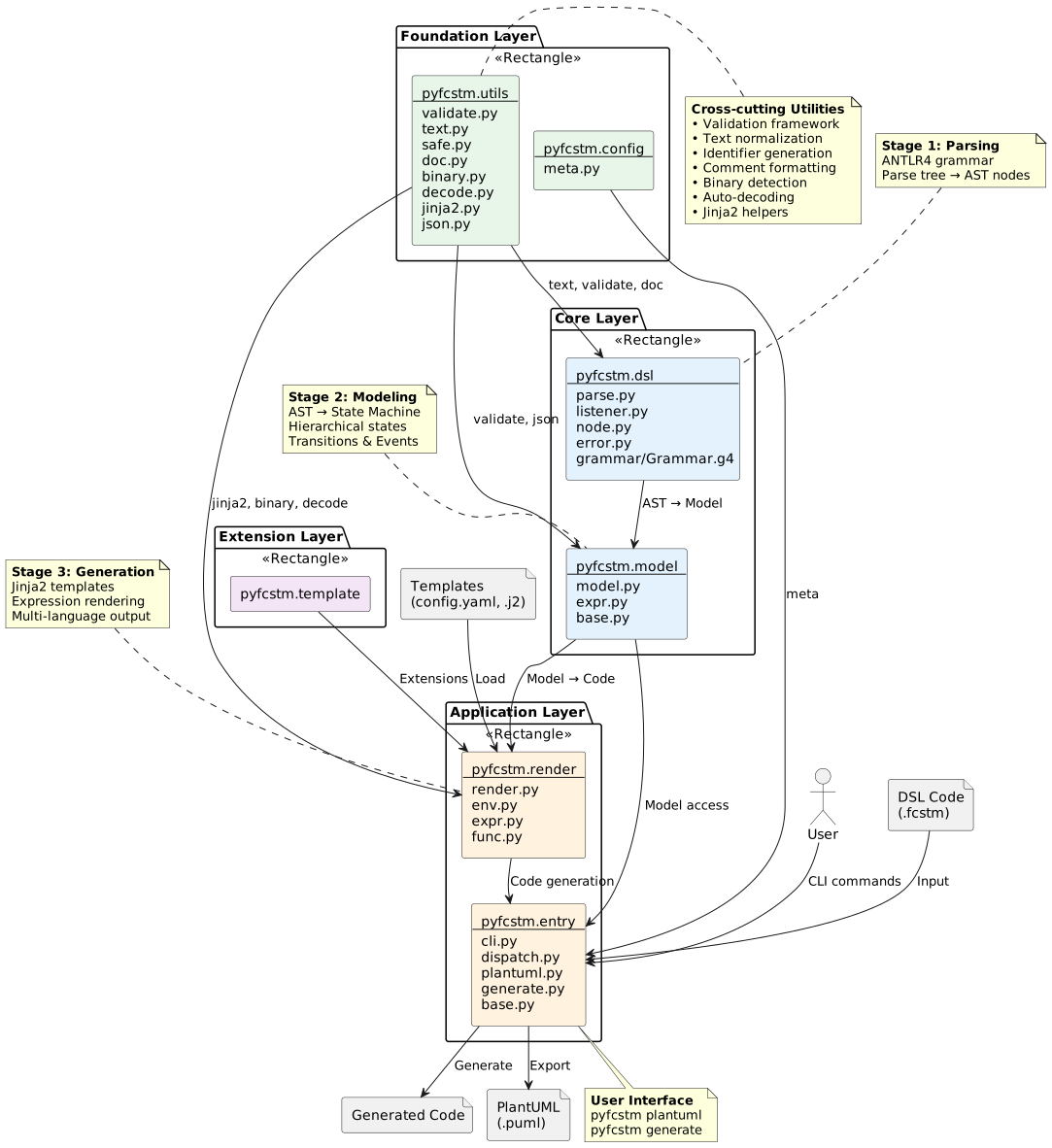
High-level repository pipeline.
The important design choice is that most features converge on the model layer. The parser should not know about target-language code generation; templates should not re-parse DSL text; visualization should not invent model facts that the importer did not produce.
Layer |
Representative paths |
Owns |
Must not own |
|---|---|---|---|
DSL parsing |
|
Grammar entry points, parse errors, AST node construction. |
Semantic validation that requires resolved model context. |
Model import and model objects |
|
States, variables, transitions, events, lifecycle actions, references, PlantUML export, validation diagnostics. |
CLI presentation or template-specific target runtime behavior. |
Simulation |
|
Executable reference semantics for cycles, events, hot starts, action ordering, and active-state traces. |
Generated target-language runtime implementation details. |
Diagnostics and verify integration |
|
Structured model facts, diagnostic messages, model-derived structural and SMT-local checks, SMT translation. |
Unbounded proofs hidden inside everyday inspect commands. |
Rendering and templates |
|
Jinja environment, expression/statement rendering, packaged template assets, generated artifacts. |
Parser grammar or simulator shortcuts. |
CLI entry points |
|
User-facing command wiring, option parsing, output routing, and command-specific error boundaries. |
Business logic that belongs in model, render, simulate, or diagnostics modules. |
Documentation and LLM assets |
|
User guides, generated resources, prompt-facing grammar guide, checksum discipline. |
Runtime-only facts that are not validated against code or documented examples. |
Why the model is central
The DSL is intentionally compact, but its semantics require resolution: transition targets need owning scopes, events need scope rules, lifecycle actions need a concrete order, and forced or combo transitions expand into ordinary model facts. Keeping that resolution in the model layer gives every downstream tool the same source of truth.
This prevents three common drift problems:
The simulator and templates disagree because each reinterprets DSL text.
The diagram output shows syntax that the model importer would reject.
Inspect reports and diagnostics describe a different graph than code generation consumes.
Command-facing flow
The public CLI commands are thin orchestrators over the same pipeline:
Command |
Reads DSL |
Builds model |
Downstream action |
External dependency boundary |
|---|---|---|---|---|
|
yes |
yes |
Runs |
None for normal use. |
|
yes |
yes |
Runs diagnostics and optional inspect-eligible verify checks. |
SMT work is bounded by explicit inspect policy knobs. |
|
yes |
yes |
Runs |
Target compilers are outside generation itself. |
|
yes |
yes |
Calls model PlantUML export and writes source text. |
No renderer required. |
|
yes, except |
yes, except |
Builds PlantUML source, then renders via |
Java/jar or remote PlantUML service may be required. |
Template asset split
Built-in templates have two homes for different reasons:
templates/is the editable repository source for maintainers.pyfcstm/template/contains packaged zip assets andindex.jsonfor installed users.
make tpl refreshes packaged assets from repository sources. Tests and CLI
paths that exercise built-in templates should enter through packaged/public
surfaces so they match user behavior. This is why documentation distinguishes
maintainer template editing from normal pyfcstm generate --template python
usage.
Diagnostics, verification, and inspect
Diagnostics and inspect output expose model facts and actionable messages. They are intentionally detailed enough to guide humans and LLM-assisted repair, but they remain bounded:
Inspect always reports parse/model facts and diagnostics.
Optional verify integration is explicit and policy-limited.
Higher-cost or unbounded verification families are not silently run by an everyday inspect command.
A diagnostic can point to a likely cause and source location; it does not replace simulation, target compilation, or generated-runtime tests.
Simulation and generated runtimes
The Python simulator is the reference executable semantics for repository alignment checks. Built-in runtime templates that claim parity should be tested against simulator traces rather than merely compiling. That gives a concrete contract for lifecycle ordering, hot starts, transition effects, and active-state updates.
Generated target runtimes still have target-language concerns: API shape, formatter stability, compiler/toolchain behavior, and integration hooks for abstract actions. Those belong in template design and tests, not in the parser.
Visualization boundary
PlantUML export belongs to the model because diagrams need resolved model facts. Rendering belongs to the CLI and optional runtime environment because it depends on Java, PlantUML jar files, remote services, file suffixes, caches, and desktop viewer behavior.
That split is why plantuml is a source-export command and visualize is a
rendering command. A user can rely on source export without having a rendering
backend installed.
Generated asset boundaries
Several repository files are generated and should not be edited directly:
ANTLR parser outputs under grammar output directories.
Packaged template zip assets and template index files after template source changes.
Documentation diagrams, demo outputs, and notebook result files generated by the documentation build rules.
Generated API reference files produced by the RST generator.
The safe pattern is always: edit the source, run the generator, review the diff, and record the verification command.
Worked trace: one source, several kinds of evidence
Consider the quick-start traffic_light.fcstm file. The same source text can
produce several different artifacts, but each artifact proves a different thing.
Step |
Component boundary |
Example command or object |
What the evidence proves |
What it does not prove |
|---|---|---|---|---|
Parse text. |
|
|
The file is syntactically valid FCSTM. |
It does not prove target runtime behavior. |
Import semantic model. |
|
The inspect report names root |
The model importer accepted names, hierarchy, variables, and transitions. |
It does not render an image or compile generated code. |
Execute reference semantics. |
|
|
Cold entry and one cycle produce a concrete active-state trace. |
It does not prove every generated target template matches the simulator. |
Inspect structured facts. |
|
|
Metrics and diagnostics are available for scripts and LLM repair workflows. |
It does not run hidden unbounded verification. |
Export diagram source. |
|
|
The model can be represented as deterministic PlantUML source. |
It does not prove a renderer is installed. |
Render a diagram. |
|
|
A configured PlantUML backend can turn the source into an image. |
It does not prove the model semantics are correct beyond the source used. |
Generate runtime files. |
|
|
The template can consume the model and write target files. |
It does not by itself prove generated runtime parity; alignment tests own that claim. |
Command boundary trace
The same traffic_light.fcstm input can pass through several command paths.
The paths are related, but each proves a different boundary. This trace is the
reason the documentation keeps CLI recipes, visualization recipes, and reference
facts separate.
Step |
Command or API layer |
Artifact |
What the artifact proves |
What it does not prove |
|---|---|---|---|---|
Parse and import |
|
In-memory semantic model |
The DSL can be decoded, parsed, scoped, and validated as a state machine. |
It does not prove any renderer, template, or external tool is installed. |
Inspect facts |
|
Human, JSON, or LLM-oriented report |
Diagnostics and metrics describe the model facts seen by pyfcstm. |
It does not execute target-language code. |
Simulate behavior |
|
Simulator transcript |
The Python simulator can execute the selected cycle path. |
It does not prove generated C/C++/Python runtime parity by itself. |
Export diagram source |
|
PlantUML text |
The model can be represented as textual diagram source. |
It does not prove Java, PlantUML, remote rendering, or visual readability. |
Render a diagram |
|
SVG, PNG, or PDF artifact |
The selected rendering backend can turn the PlantUML source into an artifact. |
It does not prove the chosen detail level is the clearest explanation; visual review owns that. |
Generate runtime files |
|
Generated runtime tree |
A packaged template can consume the model and write target files. |
It does not prove native toolchains or downstream integration tests have run. |
A failure at a later boundary should not be fixed by guessing at an earlier layer. For example, a remote PlantUML outage is a visualization-environment problem, not a DSL parser problem. Conversely, a model-validation error should be fixed in the DSL/model path before retrying templates or renderers.
Counterexamples that keep the boundaries honest
A successful
plantumlcommand only proves source export. It can succeed on a machine with no Java, no PlantUML jar, and no network renderer.A successful
visualizecommand proves renderer availability for that run, but the remote mode may send PlantUML source outside the local machine.A successful
generatecommand proves rendering completed. It does not prove that a C/C++ compiler is installed or that a native executable has been tested.A clean inspect report is useful for humans and LLM repair prompts, but it is not a promise that every possible runtime path has been explored.
Visual evidence review
The architecture figure above was regenerated from structure.puml for this
PR-Q hardening pass. It is intended to prove three relationships only:
all command-facing features share the semantic model boundary;
PlantUML source export and image rendering are separate layers;
source templates and packaged templates have different maintenance roles.
It is not an API map and it is not a substitute for the generated API reference. When this figure changes, rebuild the SVG/PNG pair and inspect the rendered HTML so that labels remain readable at documentation width.
Where to go next
Syntax and meaning: DSL semantics explanation
Runtime ordering: Execution semantics explanation
Diagnostics boundaries: Diagnostics explanation
Template design: Template rendering explanation
Grammar/editor coupling: Grammar tooling explanation