Project Structure Guide
Project Overview
PyFCSTM is a Python framework for parsing finite state machine domain-specific language (DSL) and generating executable code in multiple target languages. The project adopts a modular design and provides comprehensive parsing, modeling, and code generation capabilities.
Core Module Structure
Model Layer (pyfcstm.model)
Core components for state machine modeling and expression processing:
model.py - State machine model definitions - Core classes: states, transitions, events, operations - Hierarchical state machine support - DSL node to state machine object parsing - PlantUML export functionality
expr.py - Expression processing system - Mathematical expressions and operator support - Variable references and function calls - Expression evaluation and AST conversion - Comprehensive operator precedence handling
base.py - Export interface definitions - AST and PlantUML export capabilities - Extensible interface design - Abstract base classes for exportable objects
DSL Parsing Layer (pyfcstm.dsl)
State machine DSL syntax parsing and abstract syntax tree construction:
parse.py - Syntax parsing entry points - ANTLR4 parser encapsulation - Condition, preamble, operation syntax element parsing - Grammar entry point management
node.py - AST node definitions - Complete abstract syntax tree node types - State definitions, transitions, expressions nodes - Special state markers (INIT_STATE, EXIT_STATE, ALL)
grammar/ - Grammar rule definitions - Grammar.g4 - ANTLR grammar file - Auto-generated lexer and parser (GrammarLexer, GrammarParser) - Grammar listener implementation
error.py - Error handling - Syntax error collection and reporting - Custom error types (GrammarParseError, SyntaxFailError, etc.) - Comprehensive error listener implementation
listener.py - Parse listener - AST construction logic - Parse tree to model node conversion - GrammarParseListener implementation
Utility Layer (pyfcstm.utils)
General utilities and helper functions:
binary.py - Binary file detection using text character analysis
doc.py - Multiline comment formatting and cleanup
validate.py - Validation framework with error aggregation
text.py - String normalization and identifier generation
json.py - JSON serialization interface with YAML support
jinja2.py - Template environment enhancement with Python built-ins
decode.py - Automatic text decoding with Chinese encoding support
safe.py - Safe sequence identifier generation
Configuration and Meta Information
pyfcstm.config - Project configuration - meta.py - Project metadata definition (version, author, description)
Template System (pyfcstm.template)
Code generation template support (reserved module for future expansion)
Entry Point Layer (pyfcstm.entry)
Command-line interface and user interaction:
cli.py - Command-line main entry point and subcommand aggregation
dispatch.py - Command dispatch and version information
generate.py - Code generation command implementation
plantuml.py - PlantUML generation command implementation
base.py - CLI base functionality and exception handling
Rendering Engine (pyfcstm.render)
State machine model to code transformation engine:
render.py - Code renderer core - Template-driven code generation - Multi-language output support - Configuration-based template management
expr.py - Expression rendering - Multi-language expression format conversion - DSL, C, C++, Python style support - Template-based expression transformation
func.py - Function processing - Dynamic object creation and import - Template function registration - Configuration-to-object conversion
env.py - Template environment - Jinja2 environment configuration - Global variables and filter setup - Custom template settings
Module Dependency Relationships
The project adopts a layered architecture design:
Foundation Layer: utils, config - Provides general utilities and configuration
Core Layer: model, dsl - Defines state machine models and parsing capabilities
Application Layer: entry, render - Provides user interfaces and code generation
Extension Layer: template - Supports custom template extensions
Clear dependency relationships between modules ensure upper layers depend on lower layers, guaranteeing code maintainability and testability.
Architecture Diagram
The following PlantUML diagram illustrates the module relationships and data flow:
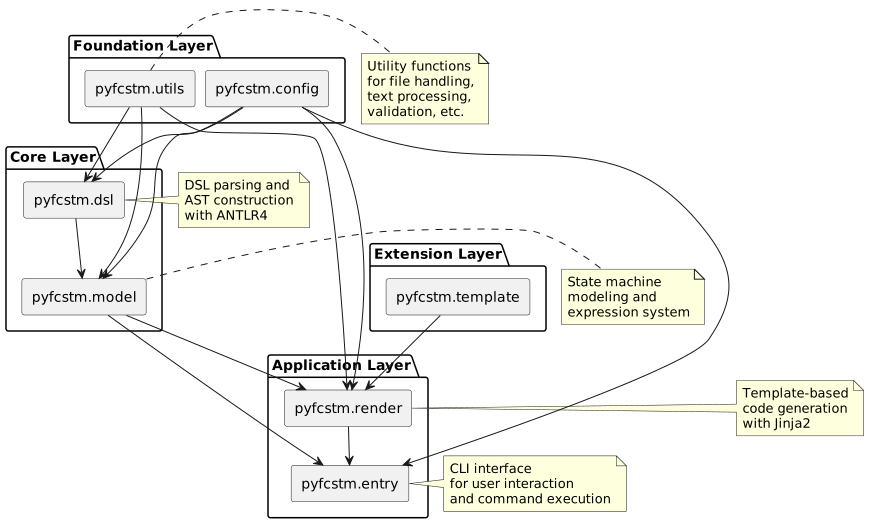
Data Flow Description:
Input Processing: DSL code → pyfcstm.dsl (parsing) → pyfcstm.model (model construction)
Model Processing: State machine model → pyfcstm.render (template rendering) → Generated code
User Interaction: Commands → pyfcstm.entry (CLI processing) → Appropriate module execution
Utility Support: All layers utilize pyfcstm.utils for common functionality
This architecture ensures separation of concerns and enables flexible extension for new target languages and template formats.